Content
Will Google Penalise Me for Using AI-Generated Content?
The honest answer to one of the most common questions in web design right now

Glenn Drain
•
It's one of the most common questions business owners are asking right now. AI writing tools have made it faster than ever to produce blog posts, service descriptions, and page copy — but alongside that convenience comes a nagging worry: is Google watching? And if it detects AI-generated content, will it bury the site in search results?
The honest answer is more nuanced than a simple yes or no — and understanding it properly will help you make much smarter decisions about how you use AI in your content strategy.
What Google Actually Says
Google's official position is clear, and it's worth starting there. Google does not penalise content simply because it was produced with the help of AI. What Google penalises is content that is low quality, unhelpful, or produced primarily to manipulate search rankings — regardless of how it was created.
In Google's own words, its focus is on rewarding content that demonstrates experience, expertise, authoritativeness, and trustworthiness — commonly referred to as E-E-A-T. A well-written, genuinely useful article that was drafted with AI assistance and then reviewed, edited, and enriched by a human expert can meet that standard. A hastily generated wall of text stuffed with keywords that answers no real question and helps no real person cannot — whether it was written by a human or a machine.
The distinction Google is drawing is not between human content and AI content. It's between helpful content and unhelpful content.
But There Is a Real Risk — and It's Not the One Most People Expect
Here's where it gets important for businesses thinking practically about their websites.
The risk with AI-generated content is not primarily a penalty from Google. The risk is subtler, more pervasive, and harder to recover from: the content simply isn't very good, and people can tell.
AI writing tools are trained on vast amounts of existing online content. They produce output that is statistically representative of what already exists — which means they tend toward the generic, the safe, and the predictable.
The AI doesn't know your business. It doesn't know your clients, your market, or what makes your approach different. It doesn't have the experience that gives an opinion its authority, or the specific knowledge that makes an answer genuinely useful rather than just plausible-sounding.
The result is content that reads fluently but feels hollow. It hits the expected beats, uses the right vocabulary, and produces the right number of words — but it doesn't say anything that couldn't have been said about any of your competitors. And in a world where building trust with your website visitors is fundamental to winning clients, hollow content does quiet but significant damage to your credibility.
We've explored this in detail in our post on whether you can build an effective website using AI. The conclusion applies equally to content: AI can produce something that looks like the right answer. It cannot produce the right answer for your specific business, your specific audience, and your specific moment in your market.
The Helpful Content System and What It Means for You
In recent years, Google has rolled out what it calls its Helpful Content System — a set of algorithmic signals designed to identify and downrank content that exists primarily to attract search traffic rather than genuinely serve readers.
This is directly relevant to the AI content question. A common pattern that emerged after AI writing tools became widely accessible was businesses publishing large volumes of AI-generated articles targeting search terms, with no real editorial input and no genuine value for the reader. Google identified this pattern, and sites built on it have seen significant drops in visibility.
The tell isn't always the quality of the writing. It's the absence of genuine perspective. Content that never takes a position, never draws on real experience, never says anything specific to the business publishing it — that's what the Helpful Content System is designed to identify and discount.
What performs well, now and increasingly in the future, is content that could only have been written by someone with real knowledge and real experience. Content that answers the questions people are actually asking, in the specific voice of the business publishing it, with the kind of detail that comes from having actually done the thing being described.
Where AI Can Legitimately Help
None of this means AI tools have no place in a content strategy. Used thoughtfully, they can genuinely accelerate the right parts of the process.
Research and structure. AI tools are useful for quickly surveying a topic, generating outline structures, and identifying angles worth covering. The thinking that results from that starting point still needs to be yours.
First drafts for editing. Some writers find it useful to generate a rough draft and then rewrite it substantially — using the AI output as a prompt rather than a finished product. The key word is substantially. Light editing of AI output produces light improvements to AI output.
Routine, low-stakes copy. Meta descriptions, alt text, short product descriptions, form labels — these are places where AI assistance can save time without meaningful quality risk, because the content is functional rather than persuasive.
Ideation. AI tools can be useful for generating topic ideas, headline variations, and angles you might not have considered. The execution still needs to be human.
What AI cannot do — and this is where the risk lies for businesses who over-rely on it — is produce the content that actually builds authority and wins trust. The case study written from your own experience of a client project. The opinion piece that takes a clear position based on years of working in your industry. The service description that speaks precisely to the fears and ambitions of your specific ideal client. These require a human being who knows things, has done things, and can write with genuine conviction.
What This Means for Your Website Specifically
If you're a small business wondering whether to use AI to populate your website with content, here's the practical framework:
Your core service and sector pages should not be AI-generated. These pages are doing the heaviest trust-building work on your site. They need to reflect your actual voice, your genuine expertise, and your specific understanding of your clients' problems. A page that could have been written about any business in your industry is a page that gives a visitor no reason to choose you over any other.
Your blog is where quality compounds. A well-written, genuinely useful blog post does several things simultaneously: it demonstrates expertise, builds authority with Google, answers questions that potential clients are searching for, and gives people a reason to stay on your site and explore further. Website conversion improves when visitors engage with content that helps them. A blog built on AI-generated posts provides none of those benefits reliably.
Thin content hurts more than no content. One of the clearest findings from Google's helpful content updates is that a site with a small number of genuinely good pages consistently outperforms a site with a large volume of mediocre ones. If AI-generated content is making your site bigger but not better, it may be actively working against you.
Your long-term visibility depends on being genuinely findable. Why customers can't find you on Google is a question with multiple answers — but one of them, increasingly, is that the site doesn't demonstrate the kind of real expertise and genuine helpfulness that Google's systems are designed to surface. AI-generated content at volume tends to push a site in the opposite direction.
The AI Search Dimension
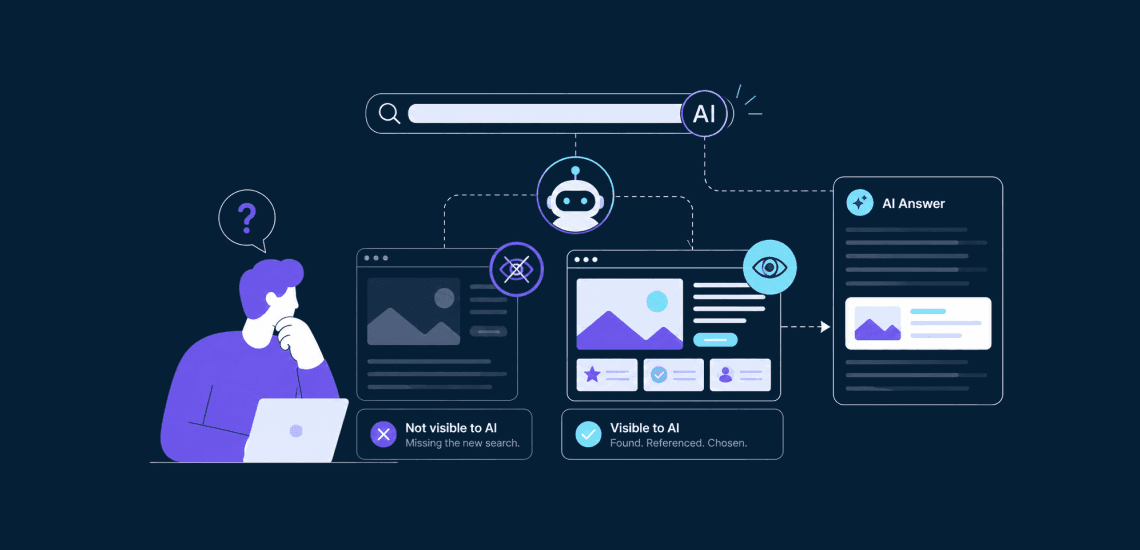
It's also worth considering a dimension beyond Google's traditional search results: AI-powered search tools like Google's AI Overviews, and conversational search platforms like ChatGPT and Perplexity, are increasingly where people find answers and make decisions about which businesses to contact.
These systems don't just index pages — they assess the quality, specificity, and authority of the content they find. A website built on generic AI content is unlikely to be cited as an authoritative source by an AI system that is itself capable of generating generic content. What gets surfaced in AI-generated answers is content that demonstrates genuine expertise and specific, credible knowledge — exactly the content that AI tools alone cannot produce.
The businesses building authority in AI search are the ones investing in real content: detailed case studies, specific opinions, genuine expertise written down clearly. Web design is changing rapidly, and so is the search landscape around it. The content strategy that wins in 2026 and beyond is the one that takes quality seriously.
The Short Answer
Will Google penalise you for using AI-generated content? Not automatically, and not simply because AI was involved. But if AI-generated content means low-quality, generic, unhelpful pages that don't reflect genuine expertise — which it often does when used without sufficient editorial input — then yes, your search visibility will suffer. Not from a penalty, but from simply not being good enough to rank.
The businesses that will win in search over the coming years are the ones producing content that only they could produce. Content with real experience behind it, real opinions in it, and real value for the people reading it.
That's a higher bar than generating a blog post in thirty seconds. It's also the only bar worth clearing.
How can we help?
At Made For Web, we work with businesses, professional services, and organisations across Northern Ireland and the UK to design websites that are sharp, fast, and built around the people they need to reach. Every project starts with a conversation with no obligation, just an honest discussion about what you're trying to achieve.