Content
Is Your Website Invisible to AI?
Why Business Websites Need to Be Built for the New Search

Glenn Drain
•
There was a time when getting found online meant one thing: ranking on Google. Get the right keywords on the right pages, earn a few backlinks, and you were in the game.
That time is over.
Search has changed fundamentally. Your potential customers are no longer just typing keywords into Google — they're asking ChatGPT for recommendations, using AI Overviews to get instant answers, and turning to LinkedIn to validate a supplier before they even visit a website. The way businesses get discovered has fractured across multiple platforms, and most websites haven't kept up.
The good news? This shift is an opportunity. Businesses that build their websites with AI discovery in mind right now are positioning themselves ahead of competitors who are still optimising for a search landscape that no longer exists.
What Is AI Discovery — and Why Does It Matter for Your Business?
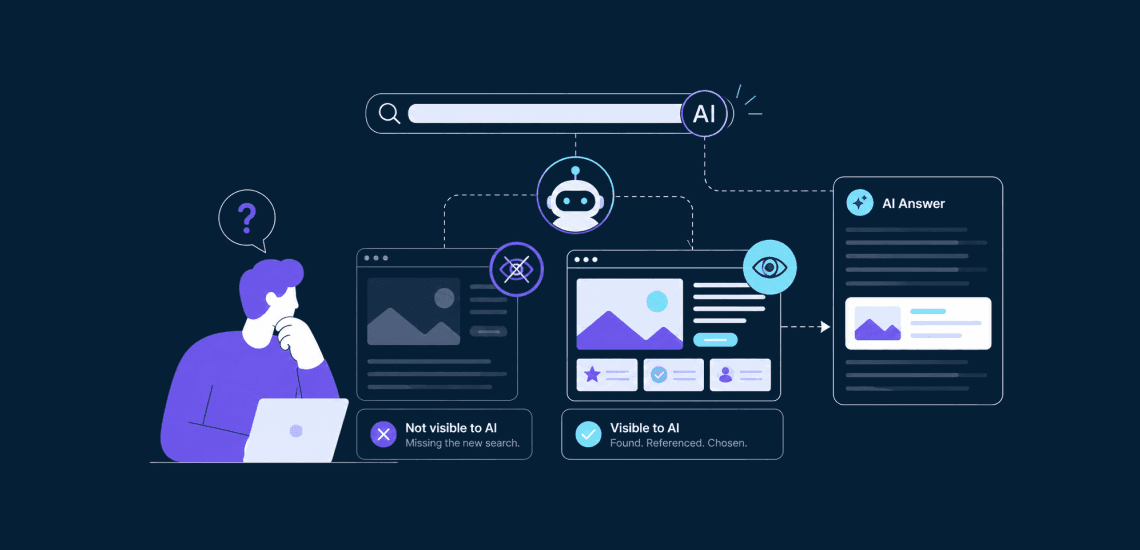
When someone types a question into ChatGPT, Google's AI Overview, or Microsoft Copilot and asks "what's the best [service] for [industry]", an AI system reads across thousands of web pages and pulls together an answer. The websites it references — and recommends — aren't always the ones with the highest traditional SEO rankings.
They're the ones that are easiest for AI to understand, summarise and trust.
That's a meaningful distinction. It means a well-structured, clearly written website from a smaller business can outperform a larger competitor if it's better built for how AI systems interpret content.
For B2B businesses in particular, this matters enormously. Your buyers are researching before they ever reach out. They're asking AI tools for shortlists. They're clicking through from LinkedIn expecting to land somewhere that immediately confirms you're credible and competent. If your website isn't designed to meet those moments, you're losing business you never even knew was within reach.
The Problem With Most Business Websites
Most business websites were designed around a traditional SEO mindset: target keyword phrases, build pages around those phrases, and hope Google sends traffic.
That approach isn't worthless — traditional search still matters. But a website built only for keywords tends to have some significant gaps when it comes to AI and modern discovery:
Pages that talk about services, but don't answer questions. AI systems are trained on how people ask. If your content doesn't reflect natural questions and clear answers, it's harder for AI to extract and use.
No clear structure for AI to follow. A wall of text or a beautifully designed visual page with minimal meaningful content gives AI very little to work with.
Weak credibility signals. When someone lands on your site from an AI recommendation or a LinkedIn post, they're looking for immediate validation. Vague messaging and unclear value propositions lose that visitor fast.
Slow or difficult to use on mobile. Performance and mobile experience directly affect how search systems, including AI, assess your site's quality.
What "Designed for AI Discovery" Actually Looks Like
This isn't about gaming algorithms or cramming content with AI-friendly phrases. It's about building a website that genuinely serves how people search and discover businesses today.
Here's what that means in practice:
Answering Questions, Not Just Targeting Keywords
Every page on your website should be built around the real questions your customers are asking — not just the search terms you want to rank for. There's a difference between a services page that says "we provide HR software solutions" and one that clearly answers "how does HR software help businesses with fewer than 50 employees reduce admin time?"
Page layouts designed around questions and intent perform better across both traditional search and AI-driven discovery, because they match how people actually think and search.
Content That AI Can Read, Summarise and Cite
AI systems need to be able to quickly understand what a page is about, extract the key information, and reference it with confidence. That requires:
Clear heading structures that signal what each section covers. Dedicated sections for FAQs, summaries and explanatory content. Distinct separation between informational content (educating a visitor), commercial content (presenting your offer) and supporting content (proof, case studies, trust signals).
When your content is well-structured and logically organised, AI is far more likely to surface it — and surface it accurately.
Consistent, Topical Authority
AI systems are looking for websites that demonstrate genuine expertise in a topic area. That means consistent presentation of your products, sectors and use cases across your site — not a collection of loosely connected pages.
If you serve three industries, each should have its own clear content that speaks to that sector's specific needs. If you offer five services, each should be presented in a way that reinforces the others. Depth and consistency signal authority. Authority gets you cited.
Credibility for LinkedIn and Social Traffic
For B2B businesses, LinkedIn is often where a potential buyer first encounters you. They see a post, an article, or a recommendation and click through to your website. What they find in those first few seconds determines whether they stay or leave.
Your website needs to be designed so that a visitor from LinkedIn, who may know nothing about you, immediately understands who you are, what you do, who you do it for, and why you're worth their time. That means clear messaging, visible social proof, and a design that communicates professionalism and trust without requiring the visitor to dig for it.
Performance and Mobile Experience
This is non-negotiable. A slow website or one that's awkward on mobile doesn't just frustrate visitors, it signals to search systems that your site isn't up to standard. Core Web Vitals (Google's set of performance metrics) remain a direct factor in search quality assessment. A well-designed, fast-loading, mobile-first website is the foundation that everything else sits on.
The Shift From "Search Optimisation" to "Discovery Design"
Traditional SEO asked: how do we get this website to rank for these keywords?
The question businesses should be asking now is broader: how do we make sure this website gets found, understood and recommended across every channel where our customers are looking?
That includes Google, yes, but it also includes AI tools, LinkedIn, industry forums, referral traffic and the AI Overviews that increasingly appear at the top of search results before any organic listings. Designing for that wider "search everywhere" reality is what separates businesses that get consistent inbound discovery from those that are increasingly invisible.
What This Means for Your Website
If your website was last designed or redesigned more than two or three years ago, it almost certainly wasn't built with any of this in mind. That's not a criticism, it simply reflects how rapidly the landscape has changed.
The businesses that will win more inbound enquiries over the next few years are those that act now to align their websites with how discovery actually works in 2025 and beyond.
We design business websites that are built to perform in traditional search and AI-driven discovery, with page structures, content architecture and design patterns that make it easy for both people and AI systems to understand, trust and recommend you.
How can we help?
At Made For Web, we work with businesses, professional services, and organisations across Northern Ireland and the UK to design websites that are sharp, fast, and built around the people they need to reach. Every project starts with a conversation with no obligation, just an honest discussion about what you're trying to achieve.