Web Design
Why Navigation Is So Important on Church Websites
Poor navigation on a church website turns visitors away before they've found what they're looking for

Glenn Drain
•
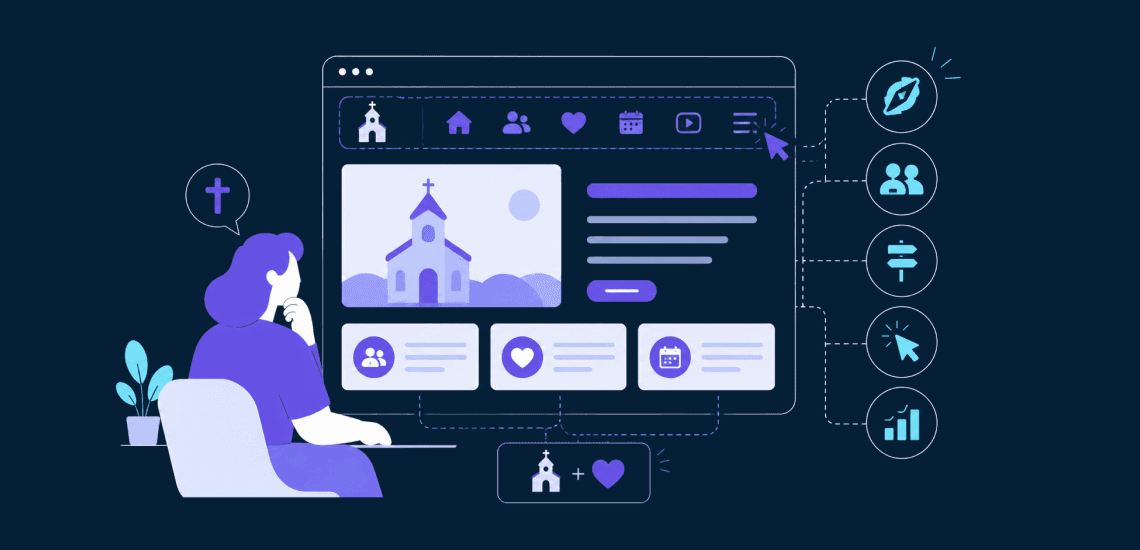
When churches think about improving their website, the conversation usually starts with design — how it looks, whether the colours feel right, whether the photography is up to date. These things matter. But there's something that has a far greater impact on whether a visitor stays, finds what they need, and feels welcomed — and it's far less visible than any of these things.
Navigation.
The way your website is structured, and the way people move through it, determines whether a first-time visitor finds your service times or gives up after two clicks. It determines whether a parent looking for children's ministry can get there in seconds or drifts off to try somewhere else. It determines whether someone exploring faith for the first time encounters a warm, clear path into your community — or a confusing tangle of menus that leaves them with no idea where to start.
Navigation isn't a design detail. It's the architecture of welcome.
The Visitor Who Doesn't Know Where to Begin
Put yourself in the position of someone visiting your church's website for the very first time. They don't know your church at all. They might be new to the area, exploring faith, or looking for a children's programme. They arrive on your homepage with a specific question in mind — what are your service times? What do you believe? Is there anything for my family?
If they can't answer that question within the first few seconds, they leave. Not because they weren't interested. Not because your church isn't right for them. Simply because the information was too hard to find.
This is one of the most common and most preventable failures on church websites. Information exists — service times, location details, ministry descriptions — but it's buried in a navigation structure that made sense to the people who built the site and no sense at all to someone arriving fresh. As we've written about before, what makes people trust a business website is rooted in clarity and ease — and those qualities begin with how a site is organised, not just how it's designed.
The Specific Challenge of Multi-Location Churches
Navigation is challenging for any church. For churches operating across more than one location, it becomes considerably more complex — and the consequences of getting it wrong are proportionally greater.
A multi-site church faces a navigational problem that most organisations never encounter: you need to serve visitors who are looking for specific, location-dependent information, while also communicating a unified identity and shared mission. A visitor looking for West Kilcooley needs different service times, a different address, and potentially different programme information than one heading to West Rathmore Road — but both belong to the same community, share the same values, and should feel that sense of belonging from the moment they land on the site.
Without a deliberate, well-structured navigation system, multi-location church websites tend to produce one of two problems. Either the site is so focused on unity that location-specific information becomes nearly impossible to find. Or the site branches so aggressively by location that the sense of shared community is lost entirely, and the church feels like two separate organisations under the same name.
Neither serves your congregation well. And neither serves the newcomer who is just trying to find out when Sunday morning starts.
The West Church Bangor Story
This was exactly the challenge facing West Church Bangor when they approached Made For Web.
West Church is a thriving Christian community serving the town of Bangor, Northern Ireland, across two distinct locations — West Rathmore Road and West Kilcooley. With multiple Sunday services, live streaming, children's ministries, and a busy programme of community events, West Church is one of the most active congregations in the area.
But their existing website wasn't reflecting that vitality. With two main church locations, multiple service times, and a wide range of ministries, the site struggled to present a clear and welcoming picture to newcomers. Information was hard to navigate. The site wasn't optimised for mobile. And it lacked the warmth and clarity needed to help first-time visitors feel at ease — or even know where to start.
The solution began not with design, but with structure. Before a single page was laid out or a colour chosen, we worked through the sitemap — mapping out who the different visitors were, what each type of visitor needed to find, and how the two locations could be clearly differentiated while still feeling like one church family.
The outcome was a clean, mobile-first website built around dedicated location pages, a prominent "I'm New" journey designed specifically for visitors who don't yet know the church, and clearly structured service information that answers the most common questions immediately. The navigation does the work of guiding people — whether they're a returning member checking event details or a family visiting for the first time — to exactly where they need to be without friction or confusion.
As Cheryl Miller from West Church Bangor put it: "Glenn is very approachable and listens to the problems you have with your website. He brought clarity and structure to our website when we were struggling to understand what we needed. And the CMS is so easy to use!"
The phrase "clarity and structure" is worth sitting with. That's not a comment about colours or fonts. That's a comment about navigation — about being able to move through a site and understand where you are, where you can go, and how to find what you came for.
What Good Navigation Looks Like on a Church Website
Whether your church has one location or five, a few principles make the difference between a navigation system that serves people and one that frustrates them.
Start with your visitors, not your organisational structure. Many church websites are structured around how the church thinks about itself internally — ministries, departments, leadership teams. But a visitor doesn't arrive thinking in those categories. They arrive with a question: Am I welcome here? What happens on a Sunday? Is there anything for my kids? Good navigation answers those questions first, and organises everything else around them.
Make the "I'm New" journey unmissable. For a newcomer to your church, arriving on a website full of information aimed at existing members can feel alienating. A clear, visible path specifically for first-time visitors — explaining what to expect, answering common questions, and extending a genuine welcome — changes that experience completely. It says: we knew you were coming, and we made this for you.
Separate locations clearly without separating the community. For multi-site churches, dedicated location pages are essential. Each location needs its own service times, address, directions, and contact information — structured clearly so that a visitor doesn't have to search for the specific details relevant to them. At the same time, the navigation should communicate that both locations are part of the same church: same values, same leadership, same community, different buildings.
Keep the main navigation simple. The temptation on church websites is to put everything into the navigation — every ministry, every programme, every team. The result is a menu that overwhelms rather than guides. The main navigation should answer the highest-priority questions for the broadest range of visitors. Everything else belongs in secondary navigation, footer links, or internal page links that lead people deeper once they've found their starting point.
Design for mobile first. The majority of people who land on your church website for the first time will do so on a mobile device — quite possibly while sitting in a car park outside your building, checking service times before they walk in. A navigation system that works beautifully on desktop but collapses into an unusable tangle on a phone is failing the people who need it most, at the exact moment they need it. Slow, hard-to-use websites lose people — and confusing mobile navigation is one of the biggest causes.
Make it findable, not just navigable. Navigation is one half of discoverability. The other half is search. A well-structured website with clear, descriptive page titles helps both visitors and search engines understand what's where. For a church hoping to reach people searching "Sunday church service Bangor" or "children's church near me," good navigation and good SEO are two sides of the same coin.
Navigation and Conversion: A Note on How This Connects
If "conversion" feels like a commercial word to use in a church context, think of it this way: every time someone visits your website and finds what they're looking for easily, that's a win. Every time they leave confused, frustrated, or empty-handed, that's a missed opportunity — not just for your church, but for that person.
The principles behind conversion optimisation — reducing friction, creating clear pathways, answering questions before they're asked — are the same principles behind effective church navigation. A well-structured site that gets a newcomer to your welcome page or service times in two clicks is doing the same job as a well-trained welcomer at the door. It removes the hesitation. It says: you're in the right place.
That's worth investing in.
Is Your Church's Navigation Working?
A useful test: ask three people who have never visited your church to find your Sunday morning service times using your current website — on their phone. Watch where they click. Watch where they hesitate. Watch what they can't find.
That exercise will tell you more about the health of your navigation than any amount of internal review. Because inside a church, we all know where things are. We know what "Kilcooley" means and which ministry meets on which night. The website needs to work for the person who knows none of that — and who is, quite often, the most important person you're trying to reach.
If the answer isn't immediately obvious, or if your church is growing and your site structure is starting to creak under the weight of more locations, more ministries, and more content than it was originally designed to carry, it's worth having a conversation about what better navigation would look like for your community.
Ready to Talk About Your Church's Website?
At Made For Web, we specialise in church web design across the UK, with particular experience in helping multi-location churches create clear, welcoming, and well-structured websites that serve both existing members and first-time visitors.
Every project starts with a conversation about your church — your community, your challenges, and what you're hoping your website can do better.
How can we help?
At Made For Web, we work with businesses, professional services, and organisations across Northern Ireland and the UK to design websites that are sharp, fast, and built around the people they need to reach. Every project starts with a conversation with no obligation, just an honest discussion about what you're trying to achieve.

